How to Price Channel Letters
The factors that drive the cost of channel letters, four pricing methods with a worked example, and how to turn your price rule into an online configurator.
Channel letters are traditionally sold on quote: a customer sends a logo or a name, the shop measures, calculates materials and labor, and replies days later. Pricing them is not mysterious, though. The cost of a set of channel letters is driven by a handful of variables, and once you know which ones matter in your workshop, you can turn them into a price rule, and even let customers get that price instantly on your website.
The numbers in this guide are examples to show the method. Use your own material costs, labor rates and margins.
What drives the cost of channel letters
- Letter height. The single biggest factor. A 24-inch letter uses far more face material, return coil, trim and LEDs than a 12-inch one.
- Number of letters. Each letter is fabricated, assembled and wired on its own. Ten letters take roughly twice the work of five.
- Font. Wide, bold letters and scripts with long strokes have longer outlines (more return and trim) than condensed fonts at the same height.
- Construction. Front-lit letters (translucent acrylic face), halo-lit or back-lit letters (light behind the letter), combination lit, or non-illuminated. Each changes the parts and the work.
- Materials and finishes. Acrylic face colors, aluminum or stainless returns, return depth, trim cap color, painted or vinyl faces.
- Lighting. LED modules, light color, power supply size.
- Mounting. Direct mount, standoffs, raceway or backer panel. A raceway or a backboard adds its own material and fabrication.
- Installation and permits, when you install. These depend on the site and are usually quoted separately from the letters.
Four ways to price channel letters
1. Price per letter, by height band
The simplest model: a price for each letter, which depends on the letter height range. For example 12 to 18 inches at one rate, 18 to 24 inches at a higher one. Easy to understand for customers and easy to put on a price list. Its weakness is that an “I” and a “W” cost the same.
2. Price per inch of letter height
Common in the sign industry: a rate per inch of height, per letter. A set of 8 letters at 18 inches is priced as 8 × 18 × rate, plus fixed costs. It scales smoothly with size, and you can keep separate rates for each construction (front-lit, halo-lit, non-lit).
3. Price by material length
The closest to real cost: measure the outline of each letter, which is the length of return and trim you will bend, and price per unit of length, plus the face area. A script word with long strokes then costs more than a short block word of the same height, as it does in the workshop. This model needs a tool that measures the text outline in each font; doing it by hand for every quote is slow.
4. Price by sign area
Some shops price the bounding box of the whole sign (width × height) per square foot or square meter. It is quick for estimates and matches how customers think about size, but it ignores the number of letters inside the box.
A worked example
A café orders “BLOOM” in front-lit acrylic letters, 18 inches high, with a white face and black returns. With a per-inch model and example rates:
| Item | Calculation | Example price |
|---|---|---|
| Letters | 5 letters × 18 in × $9 per inch | $810 |
| Power supply and wiring | Fixed per sign | $120 |
| Raceway, painted to match the wall | Option | $180 |
| Set-up and file preparation | Fixed per order | $60 |
| Total, supply only | $1,170 |
Installation would be quoted on top, after a site visit or photos. Switching to halo-lit letters would use a different per-inch rate; switching to 24-inch letters changes one number in the calculation.
Turning your price rule into an online configurator
Once your rule is written down, the same logic can run on your product page, so customers get the price as they type their name instead of waiting for a quote:
- Pick the pricing mode that matches your rule: fixed height per size, fixed width per size, or price by material length.
- Create pricing profiles with your rates per letter, per material, or both, by size range.
- Link each font to a profile and enter its letter heights, so the calculated dimensions follow the typeface.
- Describe your constructions: which parts each letter type has (face, trim, side, back lit), and the colors or finishes available for each part, with their own prices.
- Add the extras: backboards or raceways, mountings, and any option with a fixed price or a multiplier.
- Set limits: a maximum letter height, sizes where a finish is available, a minimum order price.
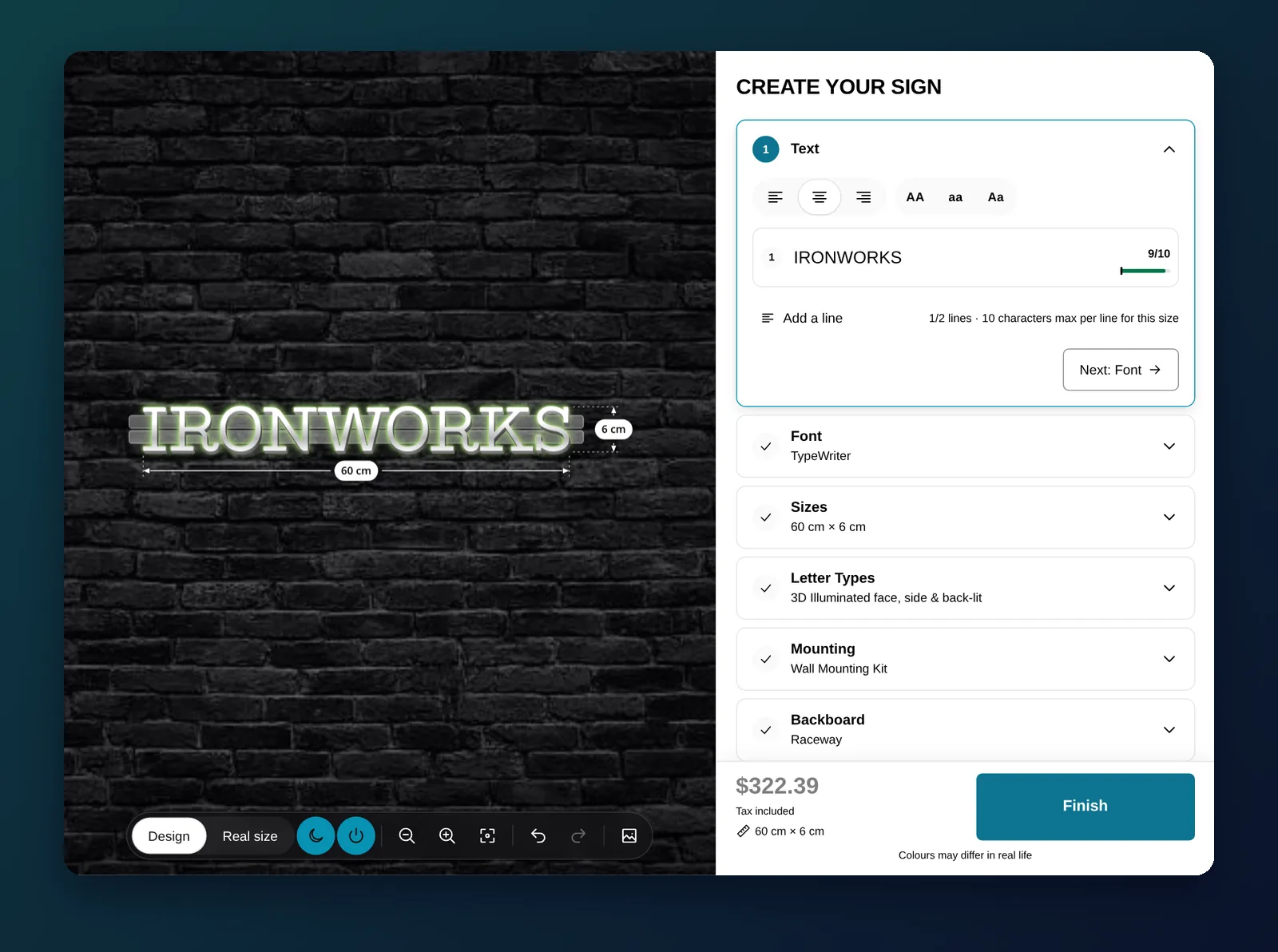
For jobs that still need a human check (very large letters, unusual sites), keep a quote request on the same page: the customer’s design arrives with the request, so your quote starts from real dimensions.
Pricing checklist
- Your smallest and largest letter sets both give a price you would accept.
- Narrow and wide fonts at the same height give different prices if they cost you different amounts.
- Fixed costs (power supply, set-up) are covered on small orders.
- Each construction (front-lit, halo-lit, non-lit) has its own rate.
- Installation and permits are clearly marked as separate when you sell supply only.
Doing it with All Sign Customizer
All Sign Customizer, the Shopify app we make, has a channel letter configurator built around these steps: pricing modes by height, width or material length, fonts with letter measurements, letter types with face, trim, side and back-lit parts, textures per part, backboards and mountings. The Channel Letter guide follows a complete acrylic letter product, and the channel letters page shows what customers see.